.jpg?width=48&height=48&name=Dylan%20Polz%20(new).jpg)
As a data center infrastructure engineer or mechanical operations manager, you are likely feeling the operational pressure of high-density AI rack deployments. Running multi-hundred-watt GPUs generates extreme thermal loads that traditional facility air systems simply cannot handle, making Direct-to-Chip Liquid Cooling (DLC) a mandatory operational baseline.
However, transitioning your thermal management strategy from air to liquid introduces a relentless physical challenge that can jeopardize your entire facility: water contamination.
In both closed technology cooling loops and open facility water systems, suspended solids, pipe debris, and mineral precipitates do not remain harmlessly in suspension. They travel directly through your pumps, heat exchangers, and precision control valves. As particulate levels rise, hydraulic resistance increases sharply, forcing your Coolant Distribution Unit (CDU) pumps to draw significantly more energy just to maintain baseline flow rates while localized heat transfer efficiency plunges.
Left unmanaged, waterborne debris degrades overall thermal capacity, forces high-value processing units into thermal throttling, and triggers unscheduled, costly facility downtime.
At HAVER & BOECKER, we partner directly with data center facility engineers, cooling system designers, and HVAC maintenance leaders to solve critical fluid purity and thermal management challenges. With decades of experience engineering precision wire mesh and filtration media, we understand the exact mechanics of fluid flow, particle retention, and pressure drop management required to keep mission-critical cooling loops operating at peak performance.
In this article, we will examine why cooling water becomes contaminated, explore the precise mechanical risks contamination poses to Direct-to-Chip architectures, and detail the measurable operational benefits of protective filtration. We will also break down how engineered woven wire mesh serves as a frontline defense for your cooling loops and provide a realistic look at where physical filtration fits within your overall water treatment strategy.
Why Does Cooling Water Become Contaminated?
For facility managers and HVAC engineers overseeing liquid-cooled data centers, understanding the origin of fluid contamination is the first step in preventing thermal degradation. Liquid cooling loops are complex, high-velocity thermal networks constantly subjected to temperature fluctuations, pressure shifts, and material interactions.
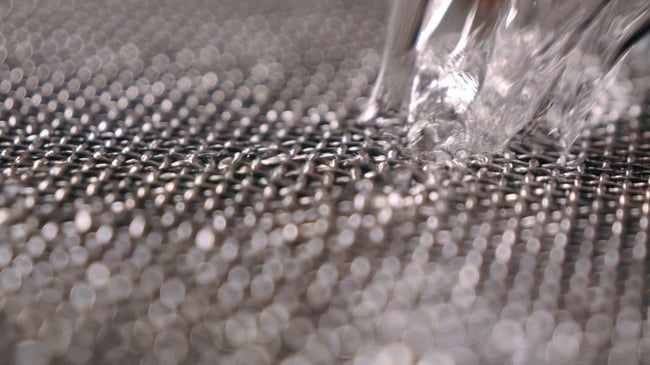
Contamination rarely stems from a single failure point but rather enters and accumulates in your system through three distinct mechanisms:
- Initial Construction & Commissioning Residuals: During loop fabrication, piping installation, or routine system maintenance, foreign matter inevitably remains inside the pipework. Metal turnings, thread sealants, copper burrs, flux, welding slag, and airborne dust become trapped during assembly and begin circulating the moment pumps are energized.
- System Component Degradation & Mechanical Wear: Continuous fluid velocity and rapid thermal cycling take a toll on internal hardware. Over time, pump impellers, elastomeric seals, structural gaskets, and internal valve components experience physical erosion, shedding microscopic rubber fragments, metal particles, and oxide flakes directly into the fluid stream.
- Chemical & Biological Reaction Byproducts: Shifts in fluid chemistry, such as pH fluctuations or glycol degradation, lead to mineral precipitation, most notably calcium carbonate scaling on high-heat transfer surfaces. In open-loop facility water systems or improperly treated loops, biological growth forms tenacious biofilms that act as adhesives, trapping suspended debris and forming thick, flow-restricting deposits.
The Dangers of Contamination in Direct-To-Chip Liquid Cooling (DLC)
For infrastructure directors managing high-density DLC environments, cold-plate integrity is paramount. In Direct-to-Chip systems, coolant is routed directly through micro-channel cold plates mounted onto processor heat spreaders.
To maximize surface area and heat transfer from multi-hundred-watt chips, these microchannel flow paths are engineered with channel widths as narrow as 100 to 400 microns.
When debris enters a DLC loop, it travels directly to the inlet of these microchannels, where it presents a severe operational hazard. Because fluid flow within microchannels is engineered to be laminar to keep pump head requirements manageable, the system lacks the turbulent force required to flush trapped solids.
Particles lodge firmly at the channel entrances, blocking coolant flow across localized sections of the die. This immediately triggers localized thermal hotspots, and as die temperatures spike, the processor automatically throttles its clock speed to prevent permanent silicon damage, severely degrading your facility's AI processing performance and compute output.
Struggling with poor flow rates and don't know the causes? Check out our article below to learn more about why this can happen and the solutions available:
Beyond localized cold-plate failure, particulate contamination threatens the broader mechanical ecosystem of your technology cooling loop through:
- Heat Exchanger Thermal Fouling: Mineral scale and circulating biofilms form an insulating layer over the internal heat transfer plates inside your Coolant Distribution Unit (CDU), driving up thermal resistance and raising overall loop supply temperatures.
- Accelerated Pump Seal & Impeller Erosion: Abrasive particulates suspended in high-velocity coolant act like liquid sandpaper, rapidly wearing down CDU pump seals, eroding impellers, and leading to fluid leaks or catastrophic pump failure.
- Hydraulic Head Loss & Elevated Costs: As debris accumulates across strainers, valves, and narrow passageways, total system pressure drop increases. Your pumps must work harder and draw substantially more kilowatt-hours to maintain target volumetric flow rates, inflating operational expenses.
The Benefits of Protecting Your Data Center’s Cooling Operations
Investing in targeted, high-efficiency filtration across your primary facility water loops and secondary technology cooling loops provides immediate, measurable returns for your facility's operational metrics.
Implementing engineered filtration allows engineering teams to move from reactive maintenance to proactive infrastructure protection by doing the following:
- Maximized Thermal Transfer Efficiency: Maintaining ultra-clean coolant prevents the formation of insulating particulate layers on CDU heat exchangers and cold plates, keeping heat transfer coefficients at design specifications.
- Sustained Compute Density & SLA Compliance: By eliminating microchannel blockages and localized hotspots, you prevent GPU/CPU thermal throttling, ensuring your clients' high-density AI workloads run at full clock speeds without performance degradation.
- Optimized Pumping Energy & Reduced Costs: Keeping flow paths clear minimizes internal hydraulic resistance, enabling pumps to maintain required flow rates at optimal efficiency curves and lowering total facility energy consumption.
- Extended Equipment Uptime & Lower Asset Wear: Removing abrasive particulates protects expensive CDU pumps, control valves, and quick-disconnect fittings from mechanical wear, extending time between failures and stretching capital equipment lifespans.

Safeguarding Data Center Performance with Engineered Wire Mesh
For data center infrastructure engineers charged with maintaining maximum uptime, selecting the proper filtration media is a critical engineering decision. Effective liquid cooling protection requires a filter media that delivers precise particle retention while maintaining low hydraulic resistance and structural integrity under high flow rates. Woven wire mesh, such as specifically engineered solutions like RPD HIFLO, provides the exact combination of pore uniformity, mechanical strength, and minimal pressure drop required for high-density liquid cooling architectures.
While engineered wire mesh provides exceptional protection against solid particulates, facility managers must evaluate filtration holistically within their complete water treatment strategy. Woven wire mesh excels at physical particle separation with virtually no head loss penalty, but it is not designed to alter fluid chemistry, control pH, or eliminate dissolved minerals. If your facility faces active chemical scaling or uninhibited biological growth, mechanical wire mesh filtration must be paired with comprehensive chemical treatment programs to ensure full operational stability.
At HAVER & BOECKER, our technical experts work directly with your engineering team to analyze fluid parameters, evaluate flow dynamics, and design custom woven wire mesh filter solutions tailored to your specific cooling loop requirements.
Looking for your next steps on how to keep your cooling water clean and how to improve the performance of your data center using wire mesh solutions? Read the article below to learn more about how RPD HIFLO can work for you: