

For plant operations managers, process engineers, and facility maintenance directors overseeing heavy industrial infrastructure, the cooling water circuit is the lifeblood of continuous production. Whether drawing from open cooling towers, local river intakes, or raw municipal supplies, industrial cooling water systems are constantly exposed to suspended solids, silt, scale fragments, and organic debris.
When left unmanaged, this particulate contamination acts as a slow-acting abrasive agent that compromises thermal efficiency and accelerates mechanical wear across the entire facility.
In many plants, water quality issues are only addressed after a sudden pressure drop or thermal spike forces an emergency shutdown. However, the true cost of inadequate water filtration manifests long before a complete failure occurs, which appears as increased energy consumption, degraded heat transfer rates, and shortened asset lifecycles.
Recognizing how particulate contamination enters and moves through fluid systems is the first step toward implementing proactive defense strategies that protect capital-intensive machinery.
This article, created for technical decision-makers tasked with optimizing plant reliability and minimizing fluid-handling overhead. The following sections examine the systemic threats posed by suspended solids, outline specific risks to core facility assets, and evaluate the operational role of industrial filtration systems in maintaining long-term uptime.
How Particulates Threaten Critical Infrastructure
As cooling water circulates through large-scale industrial loops, suspended particles ranging from windblown dust and mineral sediment to biological slime and pipe scale travel at high velocities through piping networks and internal equipment channels.
When these abrasive solids are not captured upstream, they generate severe operational friction and fouling dynamics that degrade system performance that include:
- Erosion-Corrosion Mechanisms: High-velocity water laden with hard mineral particulates scours interior pipe walls, valve trims, and pump impellers, stripping away protective passive oxide layers and accelerating metal loss.
- Thermal Transfer Impairment: Even a microscopic accumulation of suspended solids on heat transfer surfaces creates an insulating barrier, forcing systems to consume significantly more energy to achieve the required cooling delta.
- Flow Restriction and Pressure Drop: As debris accumulates at narrow fluid restrictions, localized flow velocities spike, causing turbulent flow, cavitation, and erratic differential pressure increases that strain upstream pressurization systems.
Left unchecked, these combined mechanical and thermal stressors turn cooling water loops into high-maintenance liabilities. Establishing rigorous particulate control at the front end of the system neutralizes these threats before they can propagate downstream.
Preventing Critical Equipment from Premature Failure
Protecting a facility’s mechanical core requires understanding how different asset classes interact with contaminated cooling water.
Each major component within the fluid circuit experiences distinct vulnerabilities when exposed to suspended solids, which include:
- Heat Exchangers: Plate-and-frame and shell-and-tube heat exchangers feature tight internal clearances designed for maximum thermal transfer. Particulate accumulation bridges these narrow gaps, leading to severe fouling, reduced cooling capacity, and costly chemical cleaning cycles.
- Water Pumps: Suspended grit and abrasive silt attack pump impellers and mechanical seals, causing premature wear, efficiency loss, and cavitative damage that demands frequent rebuilds.
- Valves and Flow Control: Control valves and automated actuators rely on precise seating tolerances. Trapped scale or grit prevents proper closure, resulting in leakage, wire-drawing erosion, and loss of automated process control.
- Downstream Membranes: For facilities integrating reverse osmosis (RO) or ultrafiltration loops for high-purity utility water, unprotected raw cooling feeds accelerate membrane fouling, requiring frequent chemical cleanings or premature membrane replacements.
If you want to discover more about the benefits of wire mesh in water filtration, read the article below:
Industrial Wire Mesh Solutions for Cooling Loops
When facility operating parameters demand reliable, high-integrity solids removal, industrial wire mesh filtration provides a robust mechanical alternative to fragile disposable cartridges or synthetic filter bags.
Precision-woven metallic mesh offers a fixed, non-deforming pore structure that ensures particle retention under fluctuating flow and pressure conditions.
Unlike fabric or paper media that can stretch or rupture under pressure surges, durable wire mesh handles high differential pressures and supports automated backwashing cycles or manual cleaning.
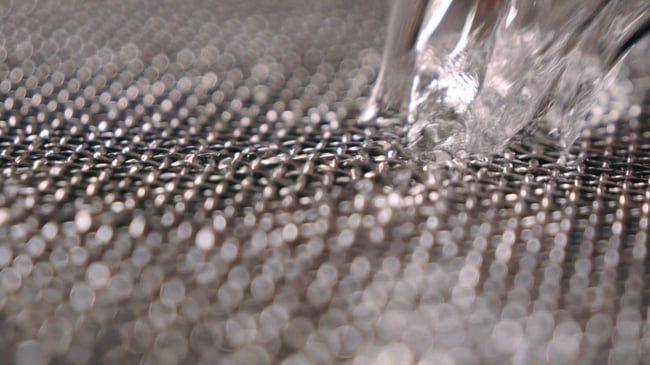
Furthermore, integrating cleanable wire mesh screens into the main water intake or slipstream filtration loops eliminates the recurring solid waste streams associated with disposable media replacement. By tailoring mesh counts and alloy selection such as 304 or 316 stainless steel to the specific chemistry and particulate load of the cooling source, plant operators achieve consistent, predictable fluid clarity without introducing unnecessary flow restriction.
Filter equipment made of woven wire mesh can be found in many types of drum filters including intake screens, multi-layer designs for self-cleaning automatic filters, filters found in the main cooling loop, single layer designs used for sock screens in the pipes, and many more applications.
This mechanical stability safeguards pumps, valves, and heat exchangers from rouge debris while maintaining steady volumetric throughput across continuous, multi-month industrial production cycles.
Investing in Reliable Cooling Water Safety
Safeguarding industrial heat exchangers, pumps, and valves against particulate contamination is a foundational operational decision that directly dictates asset availability, maintenance overhead, and long-term energy efficiency in industrial cooling water loops.
By carefully aligning precision mesh filtration geometry, robust mechanical durability, and system-specific flow parameters with your facility’s exact operating conditions, plant engineering teams can eliminate chronic fouling bottlenecks and protect thermal performance across extended production campaigns.
HAVER & BOECKER collaborates directly with OEM plant reliability engineers, equipment buyers, and maintenance leaders to design custom industrial wire mesh filtration solutions engineered specifically for demanding water systems. Backed by over 135 years of technical wire weaving expertise, HAVER & BOECKER delivers precision filtration solutions designed to secure lasting operational reliability and maximize return on your plant’s equipment investment.
Read our article below to discover more about how wire mesh solutions can benefit your water filtration process: