.jpg?width=48&height=48&name=Dylan%20Polz%20(new).jpg)
In high-throughput aggregate, mining, and industrial mineral operations, vibrating screen decks serve as the central bottleneck for material sizing and quality control. When wire cloth panels perform efficiently, material stratifies quickly across the deck, cuts remain precise, and downstream processing equipment operates at peak capacity. However, when screening media degrades or suffers from improper specification, the financial impact extends far beyond the physical cost of replacing a damaged section. Media inefficiencies quietly drain daily profitability through reduced deck throughput, off-spec product carryover, and excessive recirculating loads.
Operating worn, blinded, or incorrect wire cloth introduces subtle failure modes that aggregate producers often attribute to upstream process fluctuations. As aperture geometries deform under heavy impact or wires become pegged with near-size stones, effective open area drops rapidly. This forces material to build up into an excessively thick bed depth, causing fine particles to ride over the screen deck instead of passing through the openings. The resulting carryover overburdens secondary crushers and degrades final product stockpiles, leading to expensive re-screening cycles or rejected customer loads.
At HAVER & BOECKER, our over 135 years of experience in wire weaving and screening technology have shown us that optimizing screen deck efficiency requires matching precision wire cloth specs to exact operational demands. By manufacturing engineered woven wire mesh with precise crimp types, high-tensile alloys, and maximized open area, we help producers eliminate process bottlenecks and maximize screening profitability.
In this article, we will examine the critical warning signs that indicate your screen mesh is restricting material flow, how to evaluate screen specifications like wire gauge and weave type to prevent premature panel failure, and advanced wire mesh technologies restore lost open area.
The Key Warning Signs Your Wire Mesh Is Restricting Material Flow
Restricted material flow on a vibrating screen deck rarely happens overnight and instead manifests through subtle shifts in screen deck dynamics. One of the primary warning signs is an excessive bed depth toward the discharge end of the screen. When open area is restricted, fine material cannot pass through the mesh fast enough near the feed end.
This creates a thick cushion of accumulated material that slows down stratification, which causes usable fines to ride over the deck into the overs pile.
Another clear indicator of restricted flow is an unexplained surge in recirculating loads within closed-circuit crushing systems. When wire mesh openings become partially blinded or pegged, the screen panel fails to make a sharp separation at its nominal cut size.
As a result, properly sized material that should have passed through the deck is sent back to secondary or tertiary crushers. This non-productive recirculating loop increases energy consumption, accelerates crusher liner wear, and artificially caps total plant processing capacity.
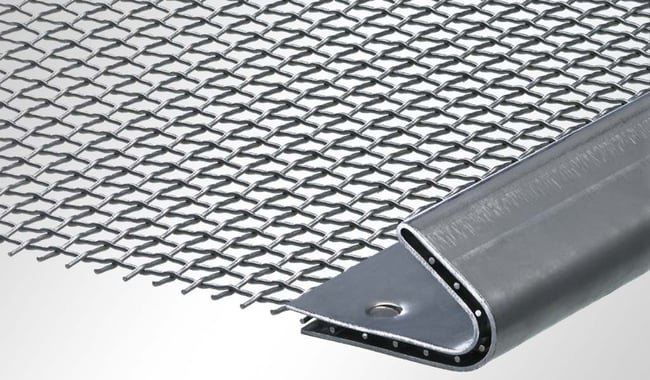
Finally, visual inspection of the material bed can reveal uneven travel velocity or “swirling” across the deck surface. When specific panels experience localized blinding or tension loss, material travel stalls over those sections while accelerating over others.
This uneven distribution reduces retention time over clean mesh areas and causes premature localized wear along high-velocity paths, signaling that screen media performance is actively compromising overall processing efficiency.
Evaluating Your Screen Specifications to Prevent Premature Failure
Eliminating screening bottlenecks requires evaluating whether the physical specifications of your wire cloth match the operational demands of your material stream. Selecting screen media always involves a direct trade-off between open area and wear life.
Heavy-gauge wire offers superior abrasion resistance against large, sharp feed material, but thick wires rescue total open area, limiting hourly throughput.
Conversely, fine-wine cloth maximizes open area and passing capacity for particle sizes from 4 mesh down to 325 mesh, but it succumbs to fatigue and breakage faster if subjected to high impact loads.
Looking to learn more about the benefits of woven wire mesh for vibrating screens and how it can fit in your system? Read the article below to discover more:
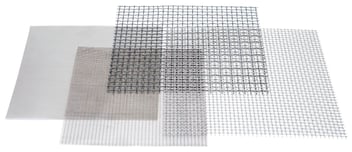
Preventing premature panel failure depends on selecting the proper wire diameter, alloy composition, and weave style for each deck level. HAVER & BOECKER offers multiple specialized woven wire mesh configurations engineered to balance open area and structural longevity:
- Square Mesh: Our standard over-under weave designed for high accuracy and precise particle separation across standard sizing applications.
- TON-CAP (Tonnage Capacity): A slotted weave constructed with heavier cross wires to maintain open area and aperture integrity under heavy material loads.
- Ty-Rod: A specialized, long-slot weave featuring openings up to two inches long, specifically engineered to maximize open area and resist blinding in fine screening.
Mismatching these parameters creates constant operational headaches. Installing fine wire with insufficient strength leads to premature wire snapping under heavy bed depth, while specifying an overly heavy wire gauge starves downstream processes.
Tailoring wire diameter and weave style to the specific deck position ensures optimal open area while preserving structural panel life.
Restoring Open Area and Eliminating Blinding with Slotted Screen Media
Handling damp, stick fines or highly abrasive, near-size material presents a continuous threat to active screening area.
Standard square mesh panels are prone to two major operational bottlenecks: blinding, where moisture causes fine clays and dust to bridge across wire intersections, and pegging, where hard near-size rocks become mechanically wedged in individual square apertures. When either condition occurs, effective open area plummets, forcing operators to halt production for manual deck scraping or water washdowns.
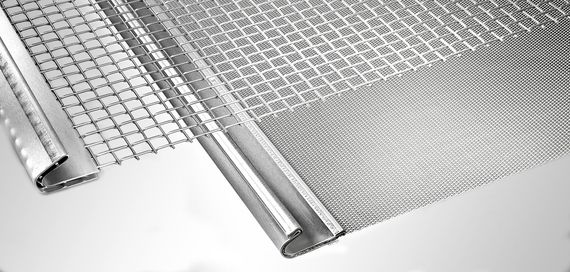
Slotted media geometries overcome these challenges by altering how material interacts with the screen surface. By stretching the aperture into an elongated rectangular opening, the media eliminates half of the wire cross-points where damp fines typically take root and bridge.
Furthermore, the longer parallel wire spans possess inherent elasticity under normal deck acceleration. This micro-vibration breaks the surface tension of wet material and continuously dislodges near-size stones before they can become wedged in the screen deck because of:
- Parallel-to-Flow Slotting: Aligns elongated openings in the direction of material travel to maximize passing velocity and accelerate the stratification of wet fines.
- Transverse Slotting: Positions slots perpendicular to material flow, creating subtle mini-barriers that slow down travel speed just enough to increase retention time for precise sizing.
Integrating slotted media into problem deck sections restores lost open area without requiring modifications to the underlying screen structure or drive mechanism.
By preventing material buildup at the wire level, plants eliminate non-productive washdown cycles, maintain consistent cut accuracy, and ensure peak hourly tonnage throughout the shift.
Stop Production Losses with the Right Vibrating Screen Media
Screening media should never be treated as a passive, disposable commodity. Worn, blinded, or improperly specified wire cloth directly harms plant profitability by restricting material flow, overloading crushers, and allowing off-spec product to reach final stockpiles. Identifying the early warning signs of restricted flow, such as deep material beds, high recirculating loads, and persistent pegging, allows aggregate producers to resolve processing bottlenecks before they lead to unexpected downtime.
Optimizing screen deck performance requires balancing open area, wire strength, and aperture geometry against the physical characteristics of your feed material. Solutions such as high-tensile TON-CAP mesh for heavy loading decks help to match precision wire cloth to your operation to ensure predictable, high-volume production.
At HAVER & BOECKER, we engineer wire cloth panels to maximize throughput, sharp cuts, and wear life across all screening environments. By controlling wire drawing tolerances, weave consistency, and panel tensioning systems, we help producers protect their shaker machinery, eliminate carryover losses, and maintain peak processing efficiency.
Want to explore more on how wire diameter and open area can impact screening capacity and how wire cloth can help solve a lot of your issues? Check out our article below to learn more: