.jpg?width=48&height=48&name=Dylan%20Polz%20(new).jpg)

Modern high-density compute architecture, where accelerator racks regularly exceed 50 to 100 kW, has shifted thermal management from an auxiliary utility to a core compute dependency. Dissipating extreme heat flux relies on steady fluid movement across primary facility water systems and secondary technology cooling loops. Yet, the heat removal capacity of any liquid loop degrades rapidly when fluid purity is neglected.
Particulate contamination acts as a quiet drag on thermal efficiency. Suspended solids adhere to conductive surfaces, obstruct narrow coolant passages, and alter fluid dynamics across heat exchangers. Over time, these physical blockages force pumps and chillers to run harder to achieve the same cooling output, eroding facility power usage effectiveness and raising thermal throttling risks for high-value silicon.
HAVER & BOECKER manufacturers precision-engineered woven wire filter media designed to maintain liquid loop purity without introducing high hydraulic resistance. Our technical specialists collaborate with data center mechanical engineers to integrate durable metal filter elements that protect critical cooling equipment.
This guide explores how circulating debris degrades thermal transfer coefficients, how elevated dynamic head loss drives up auxiliary power consumption, and how high-flow with mesh filter cloth helps preserve thermal margins. We will also outline the operational limits of mechanical filter media to support a balanced, comprehensive water management strategy.
The Thermal Impact of Particulate Buildup in Cooling Loops
Maintaining optimal thermal transfer across liquid-cooled infrastructure depends on two factors: clean metal-to-fluid contact surfaces and uniform coolant velocity.
Circulating debris, which include pipe scale, corrosion byproducts, ambient dust, and construction residue, disrupts the balance through several physical mechanisms.
When solid particles pass through a Coolant Distribution Unit (CDU) heat exchanger, they tend to settle along the thin stainless-steel plates. Because mineral deposits and iron oxides have significantly lower thermal conductivity than copper or stainless steel, this particulate layer introduces a secondary thermal resistance factor.
This layer acts as an insulator, lowering the overall heat transfer coefficient and forcing supply fluid temperatures higher to maintain target processor temperatures.

Further down the loop, direct-to-chip cooling plates utilize microchannels measuring 100 to 400 microns wide to maximize heat dissipation surface area. Particulates that bypass filtration can lodge directly at these microchannel entrances.
This creates localized flow starvation across the die, raising junction temperatures and triggering automated GPU frequency throttling even when global loop temperatures appear normal.
As particulate layers coat heat exchanger plates, the temperature differential between fluid supply and return lines narrow. To compensate for reduced heat rejection, operators must lower fluid supply temperatures or increase system pump speeds, which both increase baseline energy consumption across the facility.
Preventing Thermal Bottlenecks and Excessive Pumping Energy
Particulate buildup does more than impede heat transfer, as it actually alters loop hydraulics and inflates power draw across the facility’s pumping architecture.
It can also lead to:
- Exponential Head Loss: As debris settles in heat exchanger plates and restricts pipe passages, internal flow area shrinks. To maintain required volumetric flow rates through narrowed pathways, system pumps must generate higher differential pressure.
- Fluid Velocity Drop & Settling: If pumps cannot deliver the added pressure needed to overcome line restrictions, overall fluid velocity drops. Lower flow velocities allow suspended solids to fall out of suspension in low-velocity header legs and manifold turns, compounding the fouling cycle over time.
- Abrasive Wear on Mechanical Components: Suspended solids traveling at high velocities erode pump impellers, damage shaft seals, and score the internal seats of automated flow control valves. Damaged valve seats lose their ability to modulate flow accurately, causing hydraulic imbalances where certain server racks receive excess coolant while others suffer flow starvation.
Struggling with poor flow rates and don't know the causes? Check out our article below to learn more about why this can happen and the solutions available:
Maximizing Thermal Flow with RPD HIFLO®
Protecting thermal capacity requires a filtration element that captures fine particulates without creating a permanent pressure bottleneck inside the filter housing. While depth filters or standard square mesh can restrict fluid movement, specialized metal filter cloth achieves fine separation cut-points while maintaining high open area.
HAVER & BOECKER manufacturers RPD HIFLO® filter cloth specifically for liquid loops where minimizing head loss is essential.

RPD HIFLO® offers several performance advantages:
- High Volumetric Flow: Delivers up to twice the flow capacity of standard weaves at identical pore sizes, keeping differential pressure across the filter vessel minimal.
- Calibrated Separation Cut-Points: Available in precise pore sizes from 5 to 40 microns to trap pipe scale and airborne debris before it reaches CDU heat exchangers or cold plates.
- Durable Alloy Construction: Woven from 316 stainless-steel or other specialized alloys, the filter withstands continuous flow velocities, system pressure surges, and backwashing without structural pore deformation.
For primary facility loops requiring coarse screening or high-volume pre-filtration, plain weave is also an alternative option that can be sinter-bonded if necessary to provide a rigid, square opening structure that maintains fixed pore alignment under heavy hydraulic loads.
Optimize Your Facility Thermal Rates with Precision Filtration
Protecting thermal margin in liquid-cooled AI data centers requires active, continuous management of circulating particulates. By installing high-flow, cleanable woven wire mesh filter elements, facility operators can keep heat transfer surfaces clean, protect microchannel cold plates from clogging, and avoid the energy penalties associated with high pressure drops across filtration vessels.
At the same time, mechanical wire mesh must be integrated into a broader, multi-stage water treatment strategy. Metal filter cloth provides exceptional physical separation with minimal head loss, but it is strictly a physical barrier. Woven wire mesh does not remove dissolved minerals, reduce total dissolved solids, adjust pH, or prevent biological growth. Facilities experiencing chemical scaling or microbial activity must combine physical wire mesh filters with targeted chemical water treatment or side-stream polishing loops.
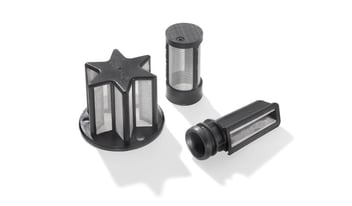
At HAVER & BOECKER, our technical team works directly with data center designers and facility engineers to analyze loop hydraulics, evaluate allowable pressure drops, and manufacture custom woven wire mesh filter elements tailored to your cooling infrastructure.
If you are looking for more methods to protect your AI data center cooling, read our article below to learn more about the benefits of wire mesh in your side-stream filtration: