.jpg?width=48&height=48&name=Dylan%20Polz%20(new).jpg)
Titanium dioxide pigment manufacturing via the chloride route demands continuous operation under severe chemical and thermal conditions. In this process, titanium-bearing ores react with chlorine gas at temperatures near 1000°C to form titanium tetrachloride, which is subsequently purified and oxidized to yield pure pigment. Managing high-temperature particulate separation directly within this primary process loop is critical for capturing raw pigment product, protecting equipment, and maintaining plant throughput.
Hot gas filter candles are deployed as vital inline production components directly downstream of chlorination reactors, fluid-bed calciners, and oxidation units. Rather than acting as a secondary waste-gas scrubber, these filter elements actively capture product particles and raw material solids directly out of the hot process stream. Because these active production gases contain dry chlorine, unreacted process vapors, and high dust loadings at temperatures ranging from 300°C to over 1000°C, media selection directly impacts daily production rates and total facility uptime.
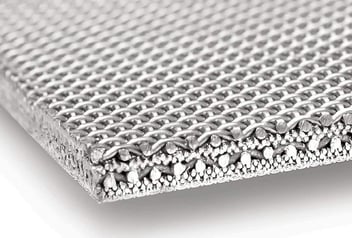
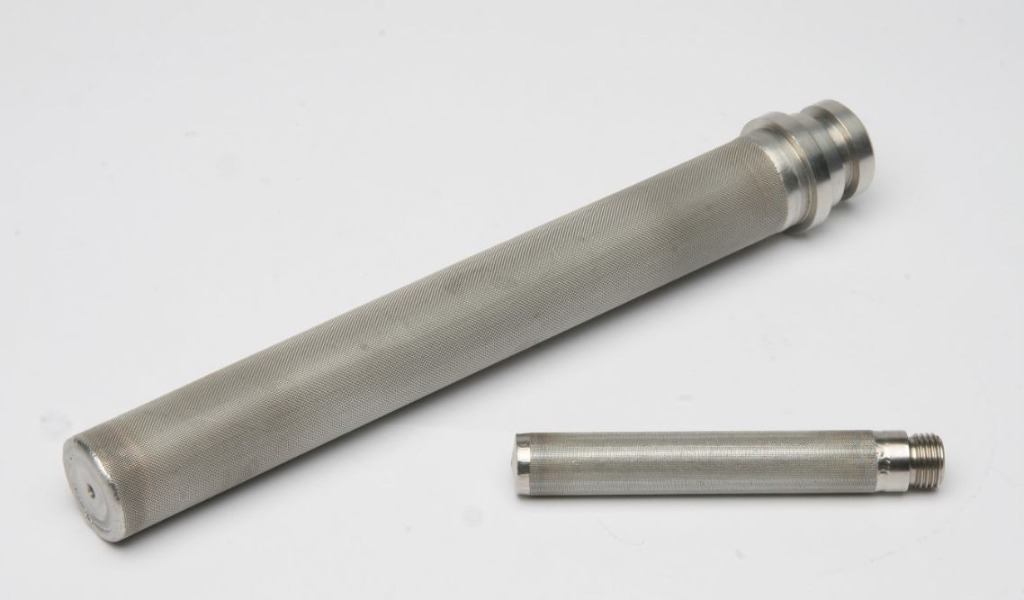
HAVER & BOECKER provides engineered porous wire mesh solutions designed specifically for high-temperature chemical processing. Utilizing multi-layer POROSTAR® sintered wire mesh laminates, HAVER & BOECKER fabricates rigid filter candles that deliver high filtration efficiency, structural integrity, and uniform permeability under severe cyclic thermal loading.
In this article, professionals such as chemical process engineers, plant operations managers, and other heads evaluating hot gas filtration infrastructure will examine the operational demands of chlorine gas filtration, compare the performance of alternative filter media form factors, and learn how sintered wire mesh filter candles resolve blinding and differential pressure instability in primary production loops.
The Challenges in Titanium Dioxide Production Filtration
Filtering high-temperature gas streams directly inside chloride-process titanium dioxide production loops exposes filter elements to extreme physical and chemical stress.

As gaseous reaction streams exit calciners and reactors, filter candles must endure three distinct operational challenges to maintain continuous plant operation:
- Halogen Corrosion and Chlorine Exposure: At temperatures as high as 1000°C, direct contact with chlorine gas, trace hydrochloric acid, and unreacted titanium tetrachloride vapors causes rapid pitting, stress corrosion cracking, and oxidation in standard structural alloys. Standard 316 stainless steels can degrade quickly in these active production streams, requiring high-nickel alloys like Inconel or Hastelloy to preserve filter life.
- Thermal Shock and Pressure Cycles: Active process filtration loops rely on periodic, high-pressure pulse-jet back-washing to dislodge accumulated product cakes from the filter elements. The contrast between high internal process temperatures and rapid, cold pulse-jet blasts subjects the filter candles to severe thermal shock and mechanical fatigue.
- Micron Particle Loading: Primary titanium dioxide particles formed during gas-phase oxidation are exceptionally fine and highly abrasive. Capturing these particles at high process velocities requires a media pore structure capable of retaining solids without causing rapid pressure spikes across the filter vessel.
Preventing Filter Blinding and Maintaining Stable Flow Rates
Achieving stable production rates depends heavily on how the selected filter media responds to heavy particulate accumulation and reverse-pulse cleaning.
Choosing an incompatible media construction leads to media blinding, which is a failure mode where fine product particles become permanently trapped inside open pores, restricting process gas flow and bottlenecking overall plant output.
Having difficulty determining if your hot gas filter is degrading? Check out the article below to discover early signs to look out for and what you can do about it:
Evaluating alternative non-woven filter media form factors highlight why traditional options frequently fail inside chloride production streams:
- Nylon and Synthetic Fabric Bags:
- Pros: Low initial purchase price and widespread availability for ambient dust collection.
- Cons: Unviable for high-temperature titanium oxide production. Synthetic polymers undergo rapid thermal breakdown at temperatures exceeding 150-200°C. Furthermore, exposure to hot chlorine gas rapidly destroys polymer binders, resulting in immediate element tearing, massive product loss, and unscheduled process shutdowns.
- Ceramic Filter Candles:
- Pros: High continuous temperature tolerance and complete immunity to oxidation.
- Cons: Highly brittle material structure. Ceramic candles are exceptionally vulnerable to mechanical vibration and thermal shock caused by pulse-jet cleaning cycles. Thermal cycling frequently includes micro-fractures along the candle body, leading to sudden catastrophic candle breakage, product contamination downstream, and costly emergency downtime.
- Sintered Powder Metal Candles:
- Pros: High mechanical strength, rigid self-supporting structure, and resistance to high system operating pressures.
- Cons: High susceptibility to irreversible pore blinding. Powder metal media relies on a dense depth-filtration matrix. Fine titanium dioxide particles lodge deep within these tortuous internal pathways, where reversible pulse-jet cleaning cannot dislodge them. Over time, this leads to permanent differential pressure elevation and shortened element replacement cycles.
Key Benefits of Wire Mesh Filtration in Titanium Dioxide Production
Multi-layer sintered wire mesh laminates, such as POROSTAR®, eliminate the operational risks of non-woven media by utilizing a rigid, surface-loading filtration mechanism.
By diffusion-bonding multiple layers of precision-woven wires mesh into a single monolithic structure, sintered mesh filter candles provide predictable pore geometry and exceptional mechanical durability.
Woven wire mesh filter candles deliver some of the following distinct engineering advantages directly within titanium dioxide chloride production loops:
- True Surface Filtration: Unlike deep powder metal structures, sintered wire mesh retains fine particulates directly on its smooth outer surface. Accumulated titanium dioxide pigment forms a permeable surface cake that dislodges completely during automatic reverse pulse-jet cleaning, restoring initial clean pressure drop and preventing permanent pore blinding.
- Ductile Resistance to Thermal Shock: Constructed from fully ductile metal alloys, wire mesh candles withstand high-pressure reverse pulse-jet shockwaves and rapid thermal transients without cracking, spalling, or shedding fibers into the product stream.
- Custom Alloy Tuning for Process Gases: Wire mesh can be custom-woven and sintered using specialized high-nickel alloys. Utilizing Inconel or Hastelloy ensures maximum chemical resistance against hot chlorine gas and reaction vapors, preventing corrosion-induced element failure.
- Defined Pore Size and High Flow Permeability: Diffusion bonding locks individual wires permanently in place, preserving exact pore dimensions from 150-200 µm. This uniform open structure maintains high gas permeability, optimizing system hydraulics and reducing fan power consumption.
Partnering for Custom Hot Gas Filtration Solutions
Maximizing pigment yield and maintaining continuous production in chloride-route titanium dioxide manufacturing requires a dependable high-temperature filtration strategy. Switching from fragile ceramic candles or rapid-blinding media to engineered sintered wire mesh filter candles allows facility operators to eliminate sudden element breakage, stabilize differential pressure, and extend maintenance intervals across critical process loops.
Installing high-performance sintered metal candles directly downstream of oxidation reactors and calciners protects downstream capital assets, recovers valuable titanium dioxide pigment, and maintains continuous chloride recycling. By combining tailored metallurgy with cleanable surface-filtration structures, plants maintain steady production throughput while minimizing maintenance overhead.
HAVER & BOECKER collaborates directly with chemical process engineers, plant managers, and equipment fabricators to engineer custom POROSTAR® sintered wire mesh filter candles. Tailored to match exact operating temperatures, gas flow rates, and vessel dimensions, HAVER & BOECKER delivers reliable, long-lasting filtration solutions built for demanding chemical manufacturing processes.
To learn more about the strengths of wire mesh vs. ceramic hot gas filters, read the article below: