.jpg?width=48&height=48&name=Dylan%20Polz%20(new).jpg)
A highly efficient chromatography column requires an unyielding, stationary media bed to separate chemical compounds effectively. When laboratories invest in high-grade analytical or preparative resins, the assumption is that these microscopic particles will remain firmly in place throughout the operational lifecycle. However, the chemical capabilities of a stationary phase can only be realized if the material remains structurally immobilized. Without absolute mechanical stability inside the column, the internal architecture begins to fail, directly impacting the quality of the final data.
The resin bed must resist constant radial forces as pressurized mobile phase fluid continuously passes through it. If the internal containment boundaries allow even minor structural movement, the dense arrangement of the packing media degrades. This shifting breaks down the tight spatial tolerances required for consistent sample migration, altering the separation environment midway through a run. Preventing this structural breakdown is the most direct way to ensure long-term, predictable separation performance.
As an established leader in industrial wire weaving and precision fluid management, HAVER & BOECKER pairs over 135 years of engineering expertise with a focus on manufacturing cleaner, safer, and structurally reliable filtration environments. Our teams design advanced structural components specifically built to handle the intense mechanical loads found in high-performance liquid chromatography. By manufacturing porous containment structures with strict tolerances, we provide columns with the rigid mechanical base required to keep stationary phases locked in place.
This article examines why structural containment is the foundational element of column longevity. We will look at how stationary phase instability visually surfaces during an active run, analyze why uniform packing distribution relies on structurally sound support structures, and demonstrate how advanced POROSTAR multi-layer laminate prevents bed shifting and structural failures. Finally, we will outline how integrating precision woven wire mesh safeguards packing uniformity across your entire equipment fleet.
The Reality of Stationary Phase Instability
When the structural integrity of a column breaks down, the physical symptoms of stationary phase instability appear quickly on the chromatogram. Chromatographers recognize the classic signs of a failing resin bed immediately: peak splitting, extreme peak tailing, and unexpected baseline drift during what should be a standard run. These visual disruptions are not chemical anomalies but are actually direct indicators that the internal geometry of the column has shifted and the sample is no longer migrating along a uniform path.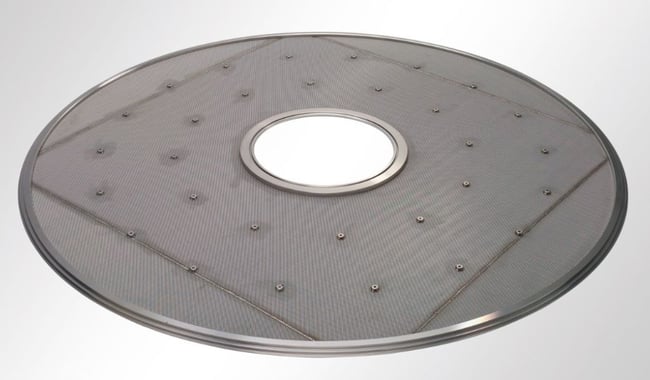
As the packed resin bed loses its physical support, individual beads consolidate into tighter arrangements or migrate toward areas of lower resistance. This internal movement alters the physical distance traveled by different portions of the same sample injection. Because the fluid path is no longer uniform across the diameter of the column, the target molecules hit the detector window at varying times, stretching a sharp, concentrated band into a broad, overlapping signal that complicates integration software calculations.
When a column exhibits these physical breakdown symptoms, the separation efficiency drops past the point of recovery. The instability introduces uncontrollable mechanical variables that cannot be corrected by altering mobile phase gradients or modifying temperatures. Addressable hardware degradation must be resolved at the physical boundaries of the column to stop structural failures from compromising the separation environment.
Why Uniform Bed Packing Relies on Rigid Structural Support
Maintaining a highly efficient separation requires a completely uniform bed packing density from the top of the column to the bottom. During the high-pressure packing process, resin slurry is compressed under immense forces to eliminate interstitial gaps and establish an even distribution of particles.
To keep this uniform distribution intact over hundreds of injection cycles, the internal containment screens at both ends of the column must act as structural anchors.
To learn more about the structural factors and material flaws that disrupt these ideal system conditions, read more in our article below:
If the internal support frit possesses any physical flexibility, the continuous hydraulic pressure exerted by the mobile phase causes the material to bow or flex. Even a microscopic deflection of the containment boundary alters the internal volume of the column, destabilizing the packed bed and causing:
- Localized Compression Fluctuations: When a support screen flexes under pressure, it relieves compression in some areas while over-compacting others, destroying uniform bed density.
- Particle Rearrangement: Eliminating the rigid boundary allows spherical resin beads to roll and slide into new positions, breaking up the carefully calibrated packing structure.
- Mechanical Breakdown of Media: Shifting under high pressure increases friction between the resin particles, which can fracture fragile silica or polymer beads and generate restrictive fines.
Without a non-deformable support structure, a packed resin bed remains vulnerable to ongoing physical changes. The continuous cycle of system startup, pressurization, and shutdown creates a repetitive stress environment that quickly degrades flexible components. Securing long-term packing uniformity requires a rigid material interface that maintains its physical shape under continuous operational forces.
Preventing Bed Shifting and Void Formations with POROSTAR
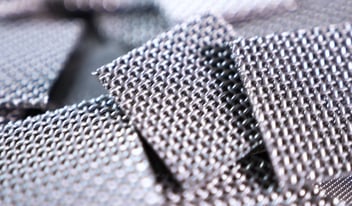
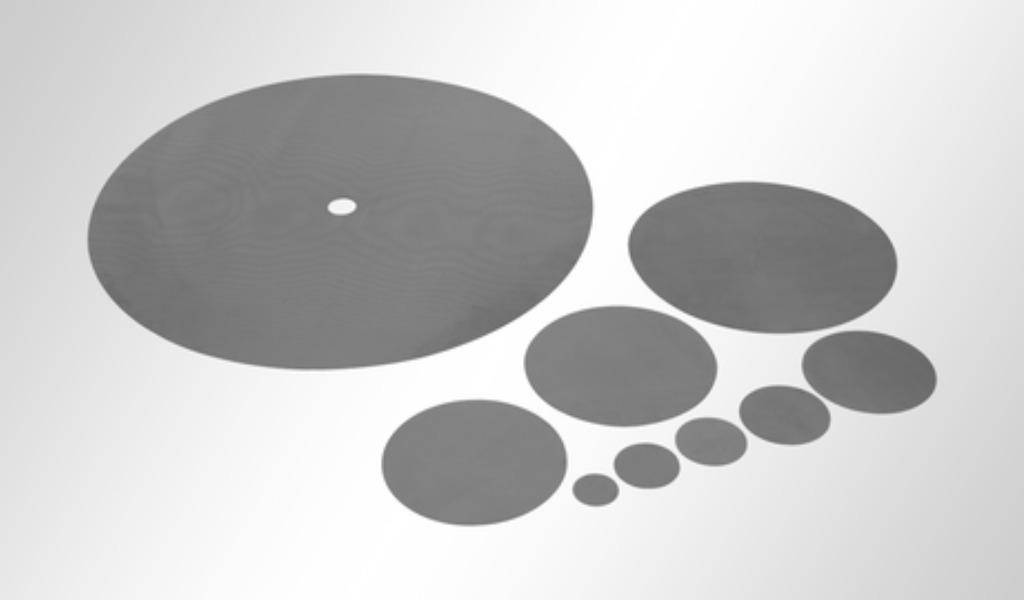
To eliminate the mechanical failures caused by traditional, flexible porous media, HAVER & BOECKER engineered POROSTAR, a specialized multi-layer sintered wire mesh laminate designed for high-strength containment. Unlike conventional metal powders or plastic frits, which are known to shift, compress, or deform under intense operating pressures, POROSTAR is constructed from individual layers of precision-woven stainless-steel cloth permanently bonded together.
This advanced manufacturing process creates a highly rigid, non-deformable structural barrier that guarantees absolute physical stability across the entire column cross-section, eliminating the primary causes of stationary phase failure such as:
- Arresting Bed Shifting: The flat surface of the sintered mesh laminate acts as a permanent mechanical stop, preventing the resin matrix from migrating or settling downward under continuous hydraulic friction.
- Preventing Void Formations: By maintaining its flat profile under peak pressures, POROSTAR ensures that the initial packing compression remains perfectly uniform, preventing the resin from pulling away from the inlet boundary to form open fluid pockets.
- Eliminating Edge Bypass: Structural rigidity ensures the mesh perimeter stays perfectly sealed against the column wall, preventing the margin gaps that allow liquid to bypass the stationary phase completely.
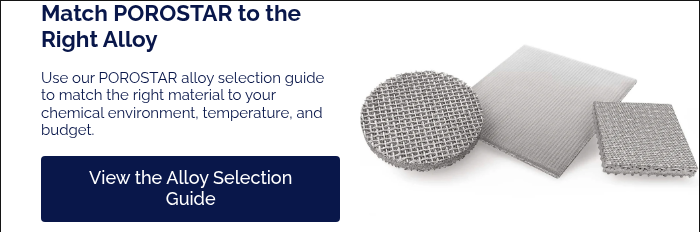
By providing a powerful structural foundation, POROSTAR stops the mechanical chain reaction that leads to bed collapse. The multi-layer matrix retains the finest chromatography resins without bowing, ensuring that the internal architecture of your column remains completely unchanged from the first injection to the last.
Protecting Packing Uniformity Through Woven Wire Mesh
Resolving stationary phase instability requires moving away from fragile, unpredictable internal materials and adopting engineered mechanical components. Attempting to fix peak tailing or void development by constantly repacking columns or adjusting software baselines only masks the underlying physical problem. Implementing highly rigid, uniform wire mesh containment structures provides a permanent solution that preserves internal packing uniformity.
The exceptional structural integrity of a sintered wire matrix like POROSTAR ensures that your column intervals can withstand continuous operational cycles without flexing or shedding material. This permanent physical stabilization keeps the packed resin securely confined and correctly compressed, drastically reducing the occurrence of internal voids and bed shifting. For analytical and production facilities, this mechanical reliability translates directly into longer column lifespans, minimal hardware downtime, and reproducible data continuity across every separation.
At HAVER & BOECKER, we engineer advanced internal components to provide cleaner, safer, and completely dependable processing environments for high-stakes facilities globally. Our over 135 years of industrial weaving heritage allows us to design and manufacture multi-layer laminates that maintain their structural shape and exact pore tolerances under intense system forces. We focus on optimizing structural rigidity and eliminating material defects so your operations can maximize equipment uptime, protect capital investments, and maintain total data reproducibility.
Want to learn more about how physical hardware engineering can establish optimal fluid boundaries and performance benchmarks? Read our previous article to learn more: